Verdun by John Mosier
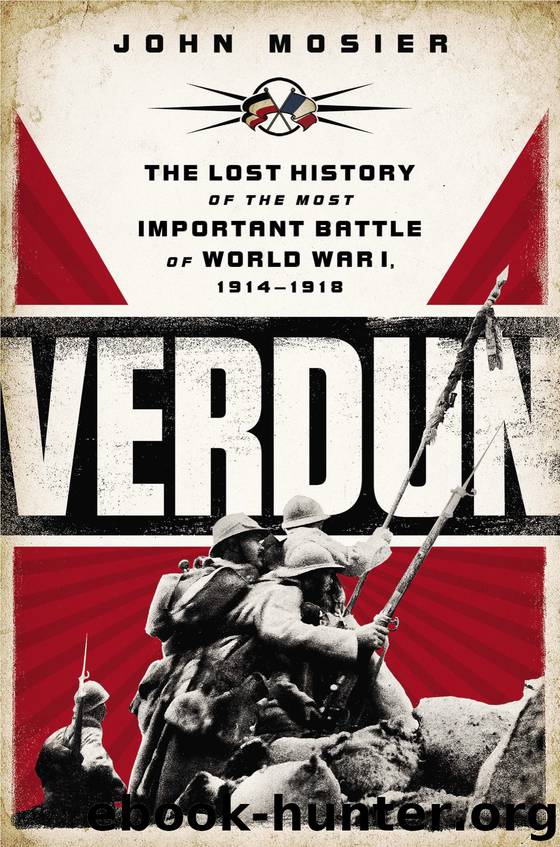
Author:John Mosier
Language: eng
Format: epub
Publisher: Penguin Group US
Published: 2013-09-02T16:00:00+00:00
7
The German Gamble
A bold stroke of this nature depends absolutely for success on a dog or a goose.
—Napoleon1
Judging from the book he wrote about his tour of the front in 1916, H. G. Wells was a terrible observer with a very poor understanding of the war. But he was not a bad judge of human beings, and one of his more intriguing remarks about the war was this:
One of the larger singularities of the great war is its failure to produce great and imposing personalities, mighty leaders, Napoleons, Caesars. I would indeed make that the essential thing in my reckoning of the war. It is a drama without a hero; without countless incidental heroes no doubt, but no star part.2
One supposes that when he wrote those lines he was thinking both of Joffre and his own Sir Douglas Haig, commander of the expeditionary force in France. The historian Phillip Guedalla put it much better when he wrote that “the combination of high office with incapacity is peculiar to these islands. It is only foreigners, decadent Latins or unwieldy Teutons, who seek out able men to be their governors.”3
Certainly by comparison with Haig, Joffre was a mental giant, albeit a slothful one. The point being that as they were not able to say much that was flattering about their own supreme commanders, the Allies took refuge in a time-honored political expedient of heaping abuse on the leaders of their enemies.
The characterizations of the German commanders are both extreme and extremely foolish. They call to mind nothing so much as Somerset Maugham’s remark about the biographer of his fictional modernist painter: “You may be sure that if Charles Strickland left a laundry bill unpaid it will be given you in extenso, and if he forebore to return a borrowed half-crown no detail of the transaction will be omitted.”4
A particular virulence is reserved for Erich von Falkenhayn, the German chief of staff from September 1914 to August 1916, probably because he was clearly the most successful and by far the most intelligent of the three commanding generals. That may sound like faint praise, given Haig and Joffre, but von Falkenhayn’s record is formidable: the successful attack on Saint-Mihiel, the seizure of Antwerp and the channel ports, the breakthrough offensive of May 1915 against the Russians, the near absolute destruction of the Serbian army that same year, the steady progress in the Argonne that so disturbed President Poincaré.
Then there was the creation of the virtually impregnable positions in the west, with the resultant serial suicides of the Allied attacks, from the First Battle of the Somme, to the failed offensives we have already seen (the Vauquois, Les Éparges, the Woëvre). And this list is seriously incomplete, as it does not include the failed offensives in Champagne and Artois, the slaughters of the Hartmannswillerkopf and the Lingekopf in the Vosges. That the GQG and its English counterpart hid the bad news, wildly inflated the German losses, and managed to spin the result of every engagement
Download
This site does not store any files on its server. We only index and link to content provided by other sites. Please contact the content providers to delete copyright contents if any and email us, we'll remove relevant links or contents immediately.
| Africa | Americas |
| Arctic & Antarctica | Asia |
| Australia & Oceania | Europe |
| Middle East | Russia |
| United States | World |
| Ancient Civilizations | Military |
| Historical Study & Educational Resources |
The Radium Girls by Kate Moore(12026)
100 Deadly Skills by Clint Emerson(4924)
Rise and Kill First by Ronen Bergman(4785)
The Templars by Dan Jones(4689)
The Doomsday Machine by Daniel Ellsberg(4489)
The Rape of Nanking by Iris Chang(4211)
Killing England by Bill O'Reilly(4001)
Stalin by Stephen Kotkin(3965)
Hitler in Los Angeles by Steven J. Ross(3946)
12 Strong by Doug Stanton(3548)
Hitler's Monsters by Eric Kurlander(3341)
Blood and Sand by Alex Von Tunzelmann(3203)
The Code Book by Simon Singh(3189)
Darkest Hour by Anthony McCarten(3129)
The Art of War Visualized by Jessica Hagy(3007)
Hitler's Flying Saucers: A Guide to German Flying Discs of the Second World War by Stevens Henry(2754)
Babylon's Ark by Lawrence Anthony(2676)
The Second World Wars by Victor Davis Hanson(2524)
Tobruk by Peter Fitzsimons(2516)
